We are a proud sponsor of Momentum, the 2014 exhibit of the Ikebana International, Ottawa Centennial Chapter 120. Please visit if you are in the area!

Ikebana At The Speech Contest
Our ikebana activity this weekend was at the 16th Atlantic Canada Japanese Language Speech Contest held at St. Mary's University last Saturday, March 8th.
Ikebana, of course, was not the main event. It was a speech contest! But we were happy for the opportunity to create ikebana arrangements for the event. The speech contest was co-organized by St. Mary's University and the Consulate General of Japan at Montreal, with support from the Japan Foundation and Mitsui Canada.
Miyako called some of her advanced students to help create a few arrangements. Here they are in action!
Val Spencer

Patti Vaison

Jean Henshall
And here are their works, displayed in various places around the Scotia Bank Theatre in the Sobey Building.
Val Spencer
Patti Vaison
Jean Henshall
...and two more.
Miyako.
A collaborative effort by Miyako and Susan Robertson, who could not be there during the actual preparations.
As the contestants battled it out, we hope the flowers made the battleground a bit more welcoming. :-) We salute all the students who joined the contest. Their speeches were high calibre, made even more commendable because we knew they had not been learning Japanese language for a long time...and we could only imagine the efforts of their teachers to help them reach such a high level! Congratulations to the winners!
Speech contest winners with Consul General Tatsuo Arai.
Our special thanks to Dr. Alexandre Avdulov of the Japanese Language and Culture Program, Department of Modern Languages and Classics of St. Mary's University, for giving us this opportunity.
Thank you Val, Patti and Jean for your time and wonderful work! Like all true ikebanistas, we know you enjoy creating arrangements...whenever and wherever!
All photos by the ikebana shop. All rights reserved.
March Break Origami Workshop
Learn something new during March break! Come join us for an early afternoon origami workshop on March 15th (Saturday) 1:00-2:00 p.m.
We've added a second session 3:00-4:00 p.m. to accommodate more people!
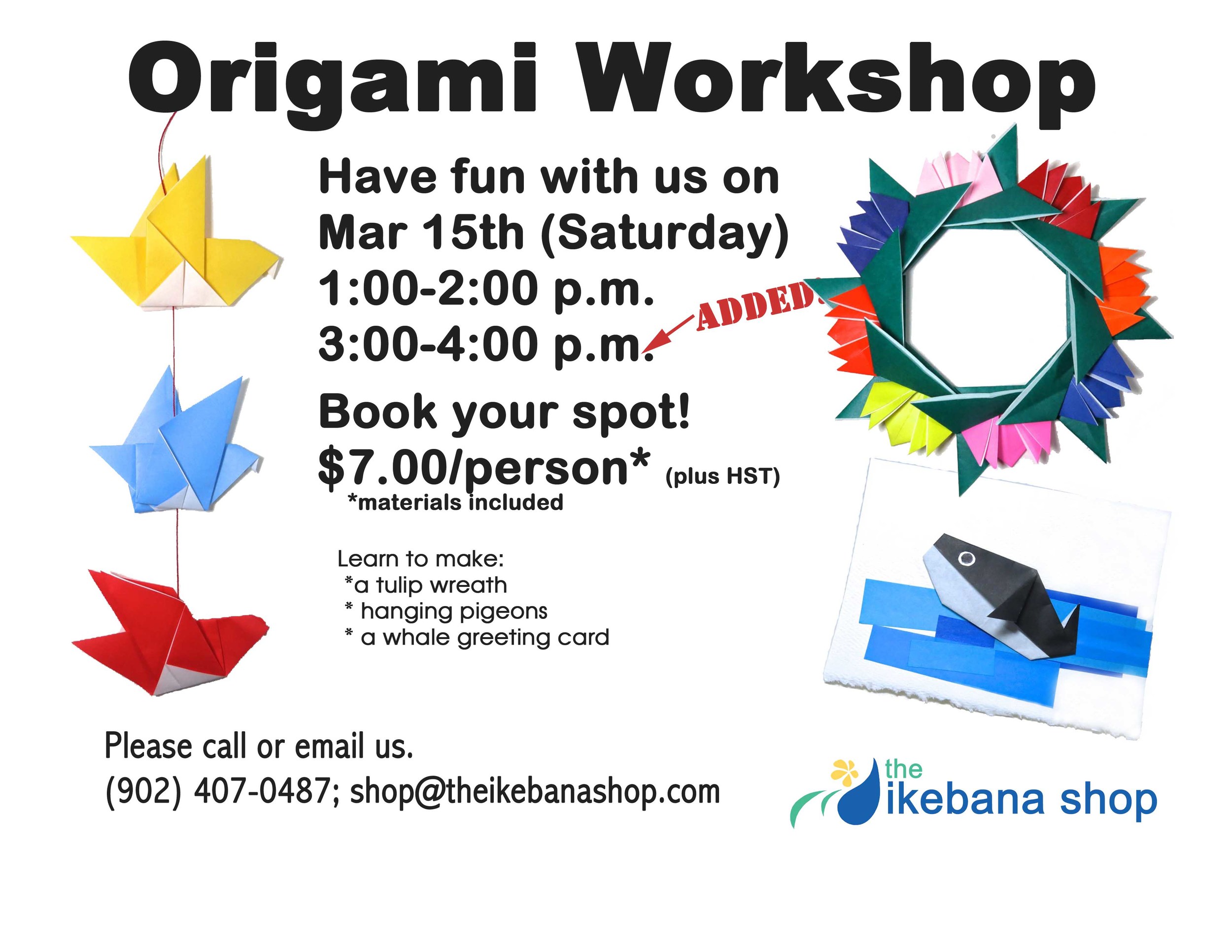
We are going to learn how to make a wreath of tulips. Then we'll string up a few pigeons and you can hang them like a mobile. Finally, we make an origami whale greeting card. It's going to be fun!
The workshop fee is $7 (plus HST) per person. This includes the cost of materials. It will be at our studio...right above the shop!
Workshop is limited to 10 participants. Pre-registration is required. Call or email us to book your spot. See you there!
The Blooming Gift Bag
So there you are collecting tiny goodies to make into one fabulous gift...or maybe you are preparing a goody bag for your daughter's birthday party...or maybe you bought this pair of origami earrings and are wondering how best to present it. Look no further. Here is the blooming gift bag! :-)
It comes flat as a pancake but you can put quite a bit inside because it has a 7cm (2.8") bottom gusset.
Dimensions: L=16cm (6.3"); H=13.75cm (5.4") with a 7cm (2.8") bottom gusset.
Here we put 10 pcs of our favourite chocolate truffles.
Bottom gusset is 7 cm (2.8") wide.
Fill it up. Then, just pull the drawstrings...and watch the flower "bloom"! :-) Tie the strings neatly in a bow.

The drawstrings are on either side of the flower.
Pull tightly to close.
Then, tie neatly in a bow.
Et voila! A super presentable gift!
Available in 4 different colours. Material: non-woven, texture polypropylene. Re-usable. Click here to purchase online.
Pink, green, orange, and light blue.
All photos by the ikebana shop. All rights reserved.
What Makes Gyokuro Special?
Many people ask us the difference between gyokuro and sencha green teas...which probably is a subtle way to ask the real question: Why is gyokuro more expensive than sencha?
The practical answer is that gyokuro tea leaves involves much more work to produce. The tea plants for gyokuro are grown in the shade about 20-30 days before harvest. That means the farmer has to put up roofing above the plants. When the shade is put up, the plants are about 70% protected from sunlight. Closer to harvest time, protection rate is moved up to about 90%...which means more roofing adjustments. (Incidentally, tea leaves for matcha are also grown this way.) On the other hand, sencha is grown in full sunlight, all the way to harvest.
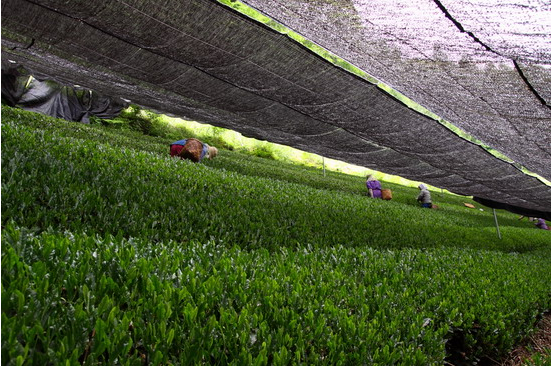
A gyokuro tea field. Photo is from this webpage: http://hojotea.com/jp/posts-504/
How different do they taste?
Very difficult to answer! If you try both teas, you will know the answer...but to put it down in words may be futile! But we shall try!
There are two Japanese expressions of taste that we would like to introduce: shibumi and umami. Shibumi is normally defined as "astringency". The Japanese would give the example of the taste of not-sweet persimmon as an example of shibumi. Yet shibumi evidently goes beyond a taste that makes us pucker our lips, especially when it comes to describing the taste of tea or wine. Umami is normally defined as "pleasant savoury taste." Still quite abstract but we may have to venture into poetry to describe it further! :-)
Now back to how the teas are grown... Photosynthesis occurs in the leaves when they are exposed to sunlight. One product of photosynthesis is the bioflavonoid, catechin. More catechin increases shibumi flavour. By suppressing photosynthesis through shading, the farmer produces tea leaves that have less catechin, thus increasing the ratio of the amino acid, theanine to catechin. More theanine increases the umami flavour.
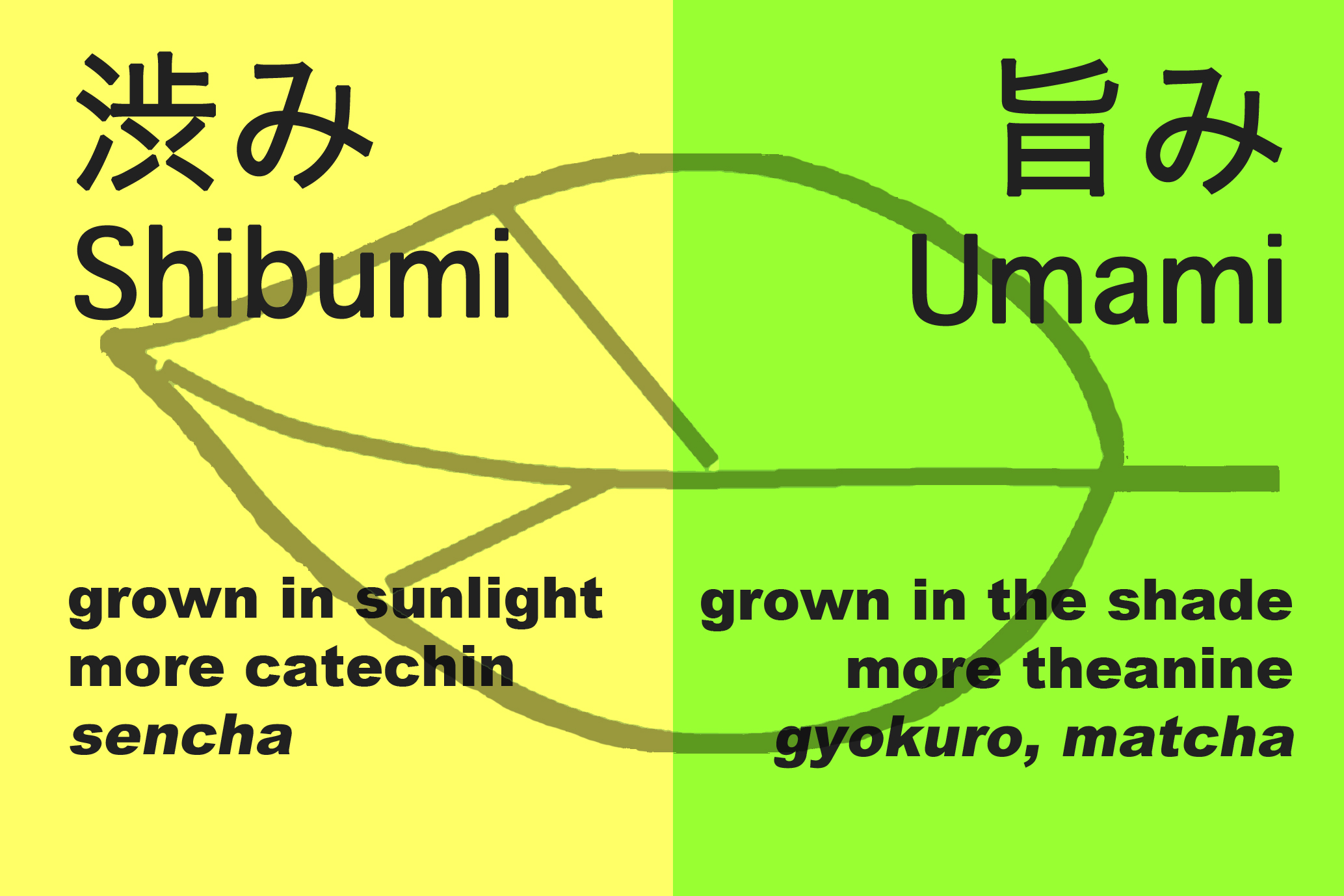
So, is the taste of gyokuro really worth the extra premium?
We will defer to the eloquence of revered Japanese writer, Natsume Soseki (whose image appears on the old 1000-yen note, by the way!) This excerpt is taken from the English translation of his 1906 novel Kusamakura (literally "The Grass Pillow"). The English title is The Three-Cornered World.
For the man of leisure there is no more refined nor delightful pursuit than savouring this thick delicious nectar drop by drop on the tip of the tongue. The average person talks of 'drinking' tea, but this is a mistake. Once you have felt a little of the pure liquid spread slowly over your tongue, there is scarcely any need to swallow it. It is merely a question of letting the fragrance penetrate from your throat right down to your stomach. On no account should it be swilled round the mouth and over the teeth, for this is extremely coarse. 'Gyokuro' tea escapes the insipidness of pure water and yet is not so thick as to require any tiring jaw action. It is a wonderful beverage. Some complain that if they drink tea they cannot sleep, but to them I would say that it is better to go without sleep than without tea.
Natsume, Soseki, The Three-Cornered World (translated from the Japanese Kusa Makura), trans. Alan Turney (1970; reprint, Washington, D.C.: Regnery Gateway Inc., 1988), 113.
No wonder some Japanese tea sets are tiny! :-) It is a matter of savouring rather than drinking. This oribe teacup is just 4 cm tall!
So now, does your gyokuro begin to taste better? :-)
Our recommended steeping instructions for different types of Japanese tea can be found here. At best, they are just suggestions. Taste is a matter of personal preference. After some trial-and-error, we hope you find the formula to best enjoy your Japanese tea!
Further reading: Umami Information by Food: Green Tea
All photos (except where cited) and infographic are by the ikebana shop. All rights reserved.
My Ikebana: Bittersweet Vine
I am very thankful to our friend, Patti, who brought us a bunch of bittersweet vine branches last autumn.
I had let them dry entwined. Now I used them for this arrangement.
It was no longer possible to bend or shape them because the branches were dry and would break easily so I had to use them in their natural state. But, I could still cut and trim, of course!
I arranged the branches to show a climbing movement from the bottom of the vase, merging with other branches at the top of the vase and still reaching further upwards. The ornithogalum moved in the same rhythm as the bittersweet.
Here is the whole arrangement.
I hope you like it. --Miyako
All photos by the ikebana shop. All rights reserved.
Creating Ripples With A Bird Mobile
Have you seen our bird mobile?
They are hand-made using cardboard stock and recycled fabric.
The birds are just for decoration but they do play an important role in the shop. It's all about energy flows. From the entrance to the back wall of our tiny shop is a straight line of walking space. We needed something to create ripples of energy at the centre of the store without entirely blocking its path. Our little birds are like rocks on a steady-flowing stream. They disrupt the current and create a few magic waves that make everything around them more interesting!
On your next visit to our shop, please look up. :-)
All photos by the ikebana shop. All rights reserved.
Valentine Gift Idea: Crane Choco Boxes
Here is a unique idea for a Valentine's Day gift: crane boxes with chocolate truffles inside!
We know they are unique because the boxes are hand-made by us in-house! :-) The box is covered with colourful Japanese fabric.
The lid comes off like this...and inside is a yummy assortment of 12 chocolate truffles.
The chocolate truffles are made by our good friends at Brockmann's Chocolate in Delta, B.C.
And of course, after the chocolates are gone, you re-can use the box for other things!
Available at the shop. 12.50 each plus HST. We don't have a lot so get yours while we still have them!
All photos by the ikebana shop. All rights reserved.
Japanesque at SMU
The annual Koshogatsu (Little New Year) celebration at St. Mary's University has evolved into Japanesque, a Japanese cultural festival. With the new format comes more flexibility as the event can now be celebrated at different times of the year and not be tied down to the Little New Year (which occurs at the first full moon of the year). This year 2014, the inaugural Japanesque was held last Sunday, Feb 2nd at SMU's Sobey building.
Dr. Alexandre Avdulov, coordinator of the Japanese Language and Culture Program, gives the opening remarks.
The event was organized by the Japanese Language and Culture Program, Department of Modern Languages and Classics of St. Mary's University, with the support of the Consulate General of Japan at Montreal. Members of the local community also shared their time and skills. Plus, the Japanese-Canadian Cultural Exchange Society of SMU was involved too.
There were many cultural demonstrations and workshops...
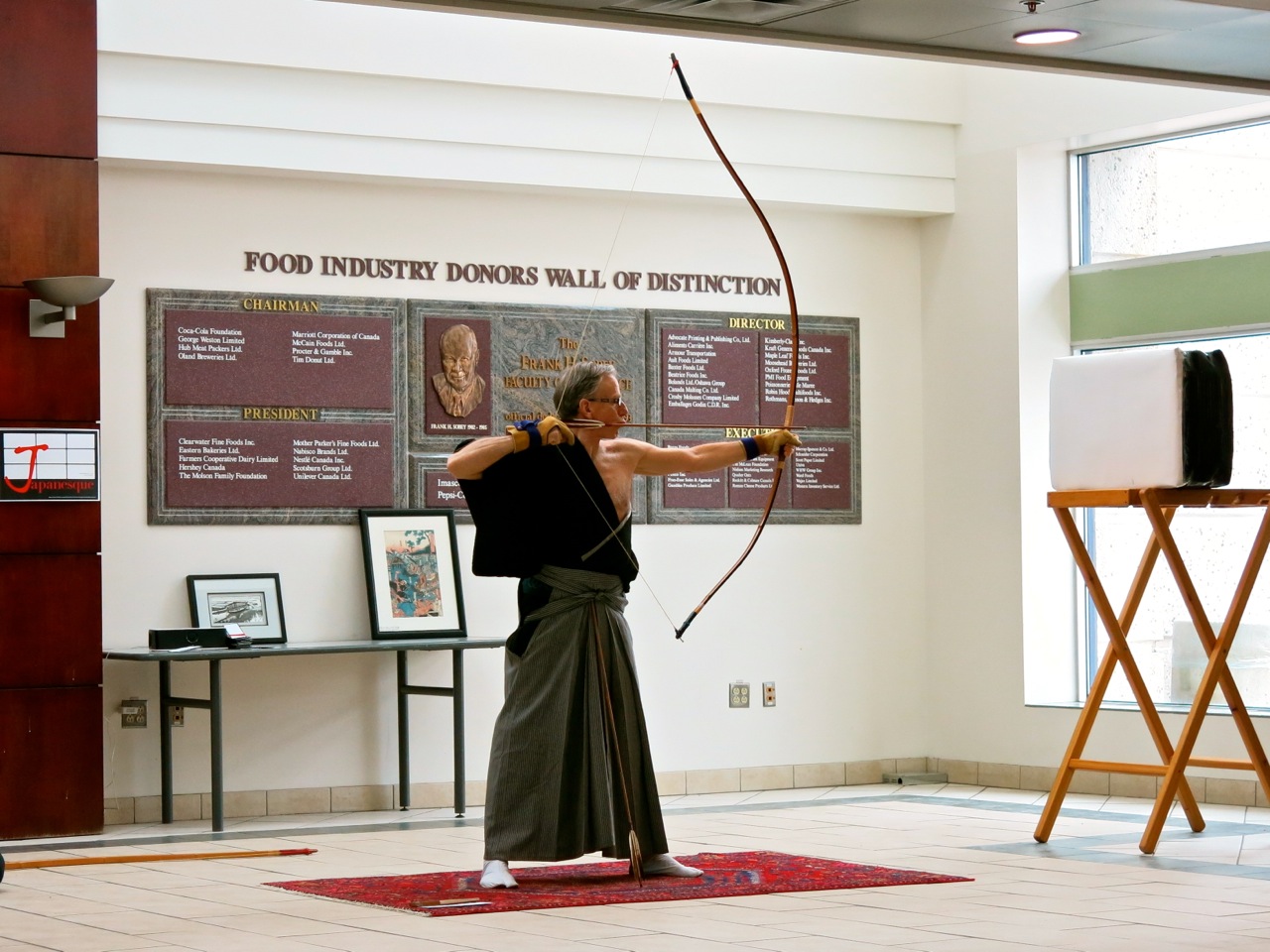
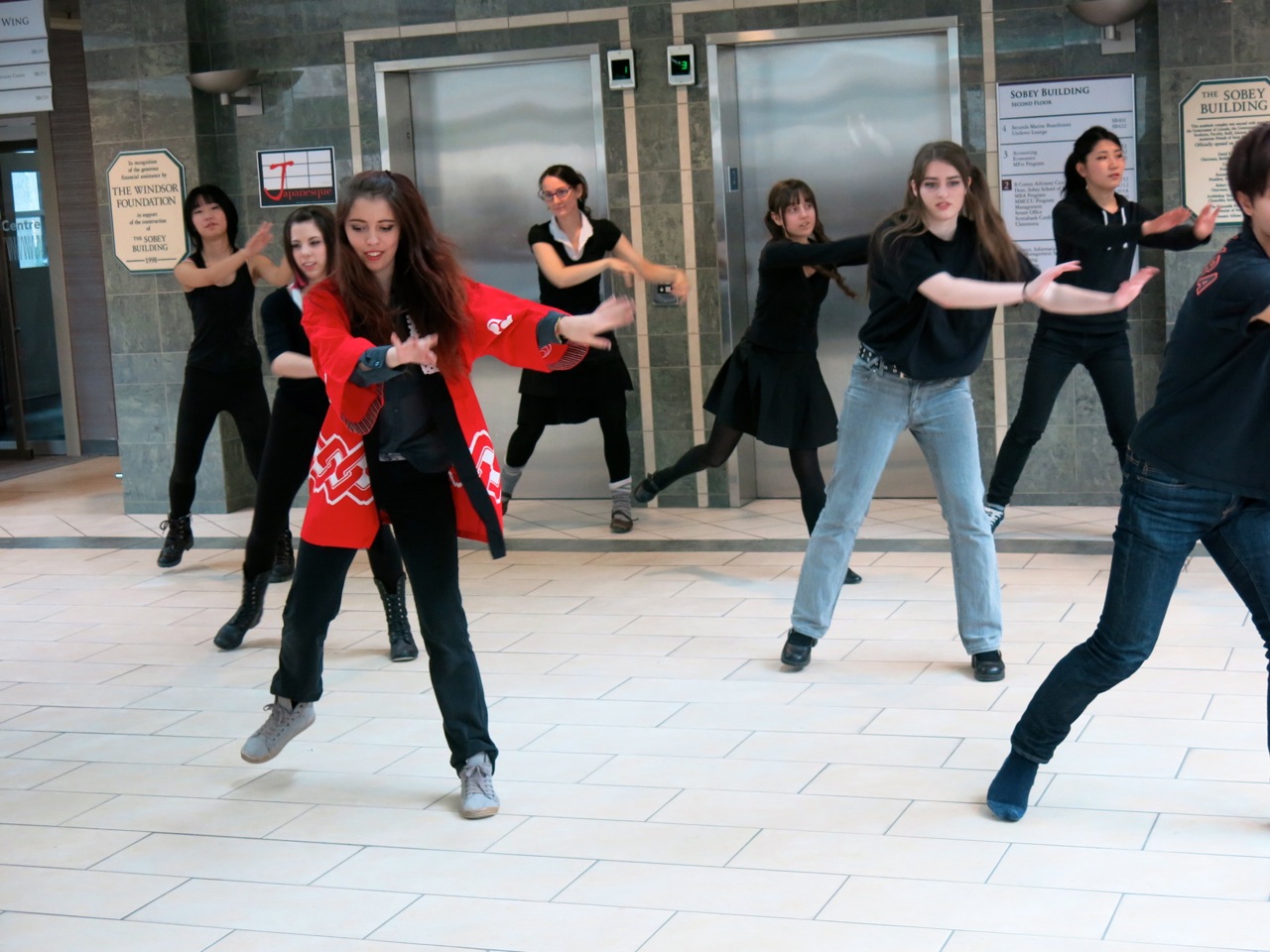
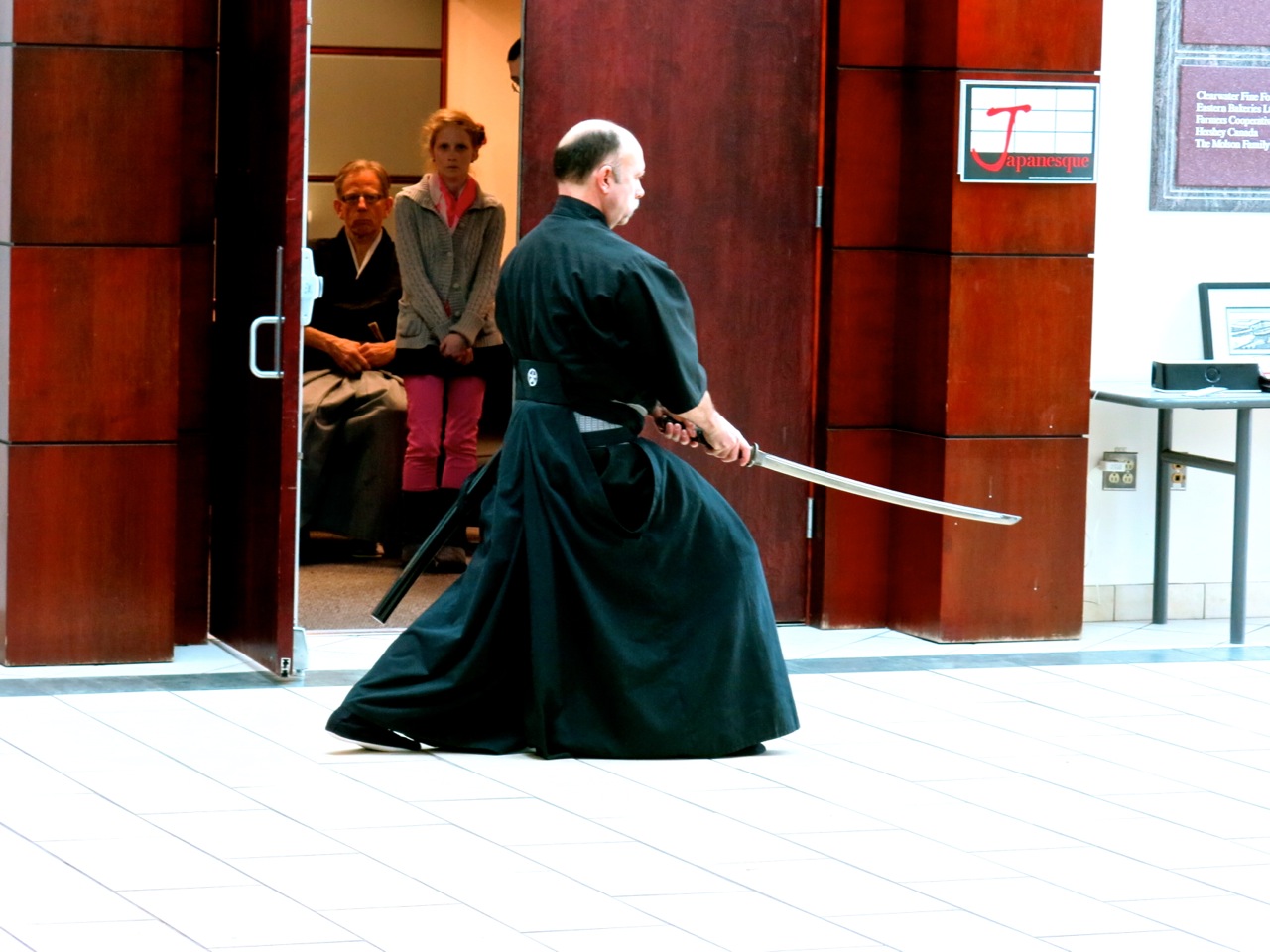
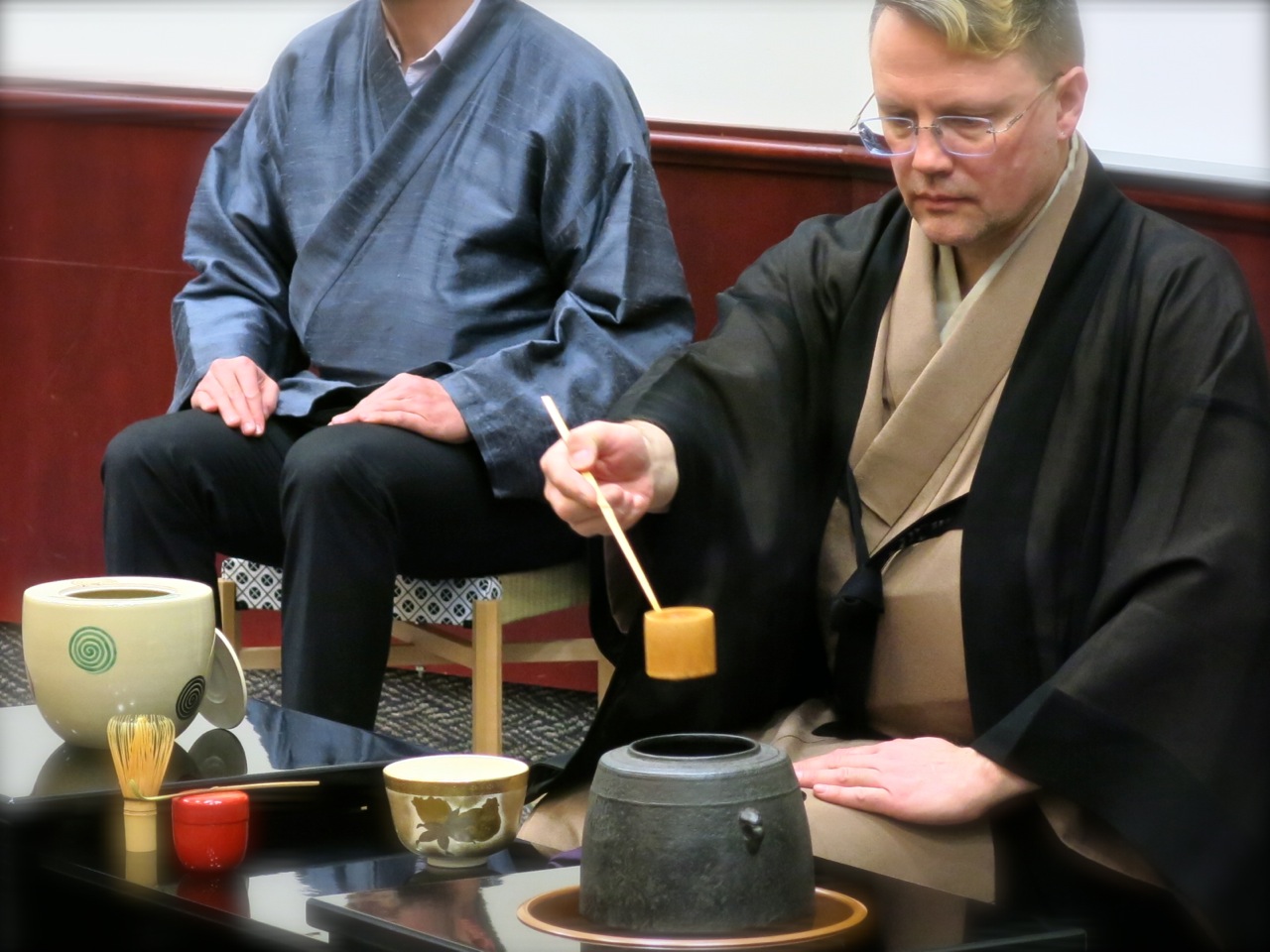
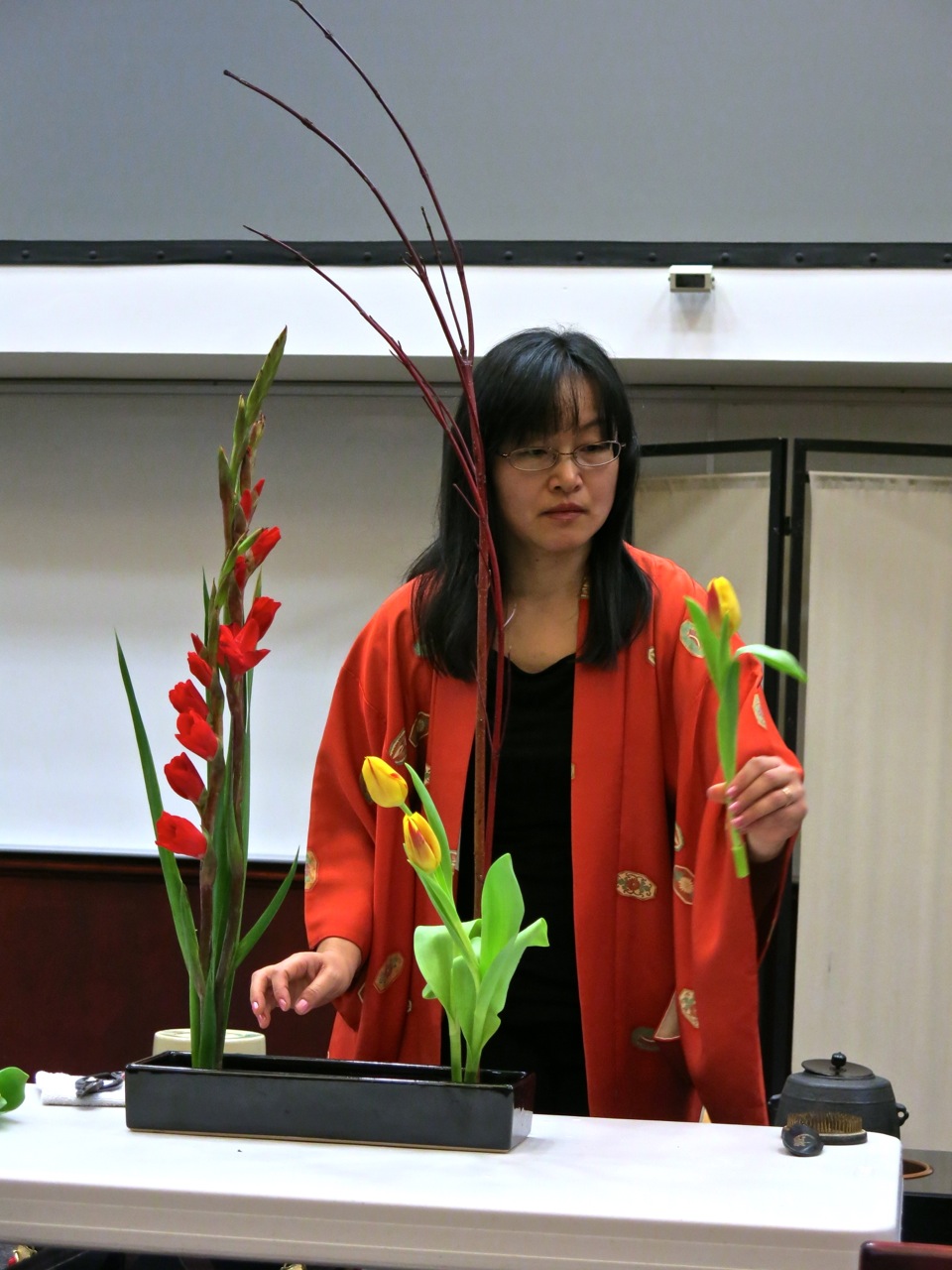
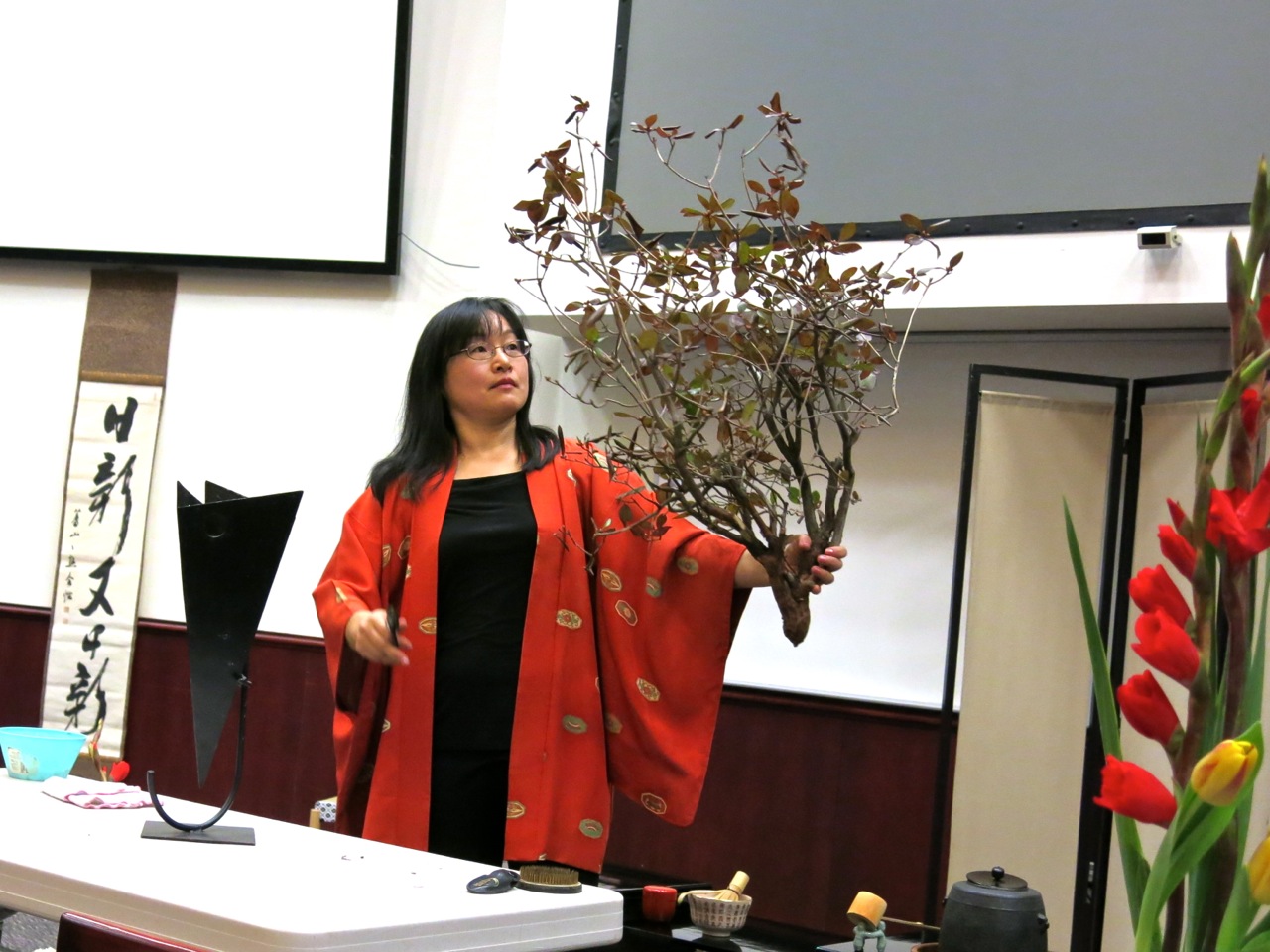
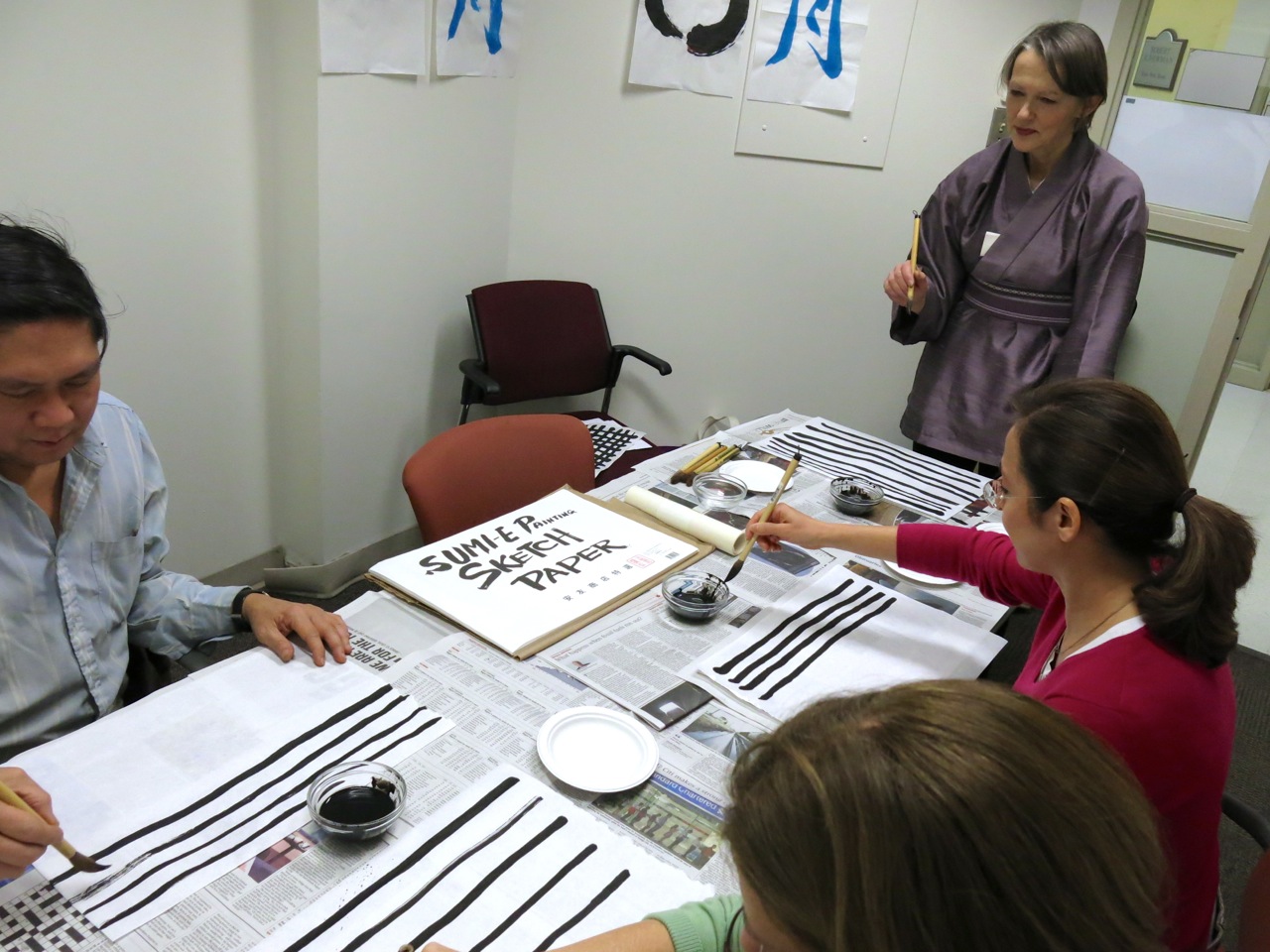
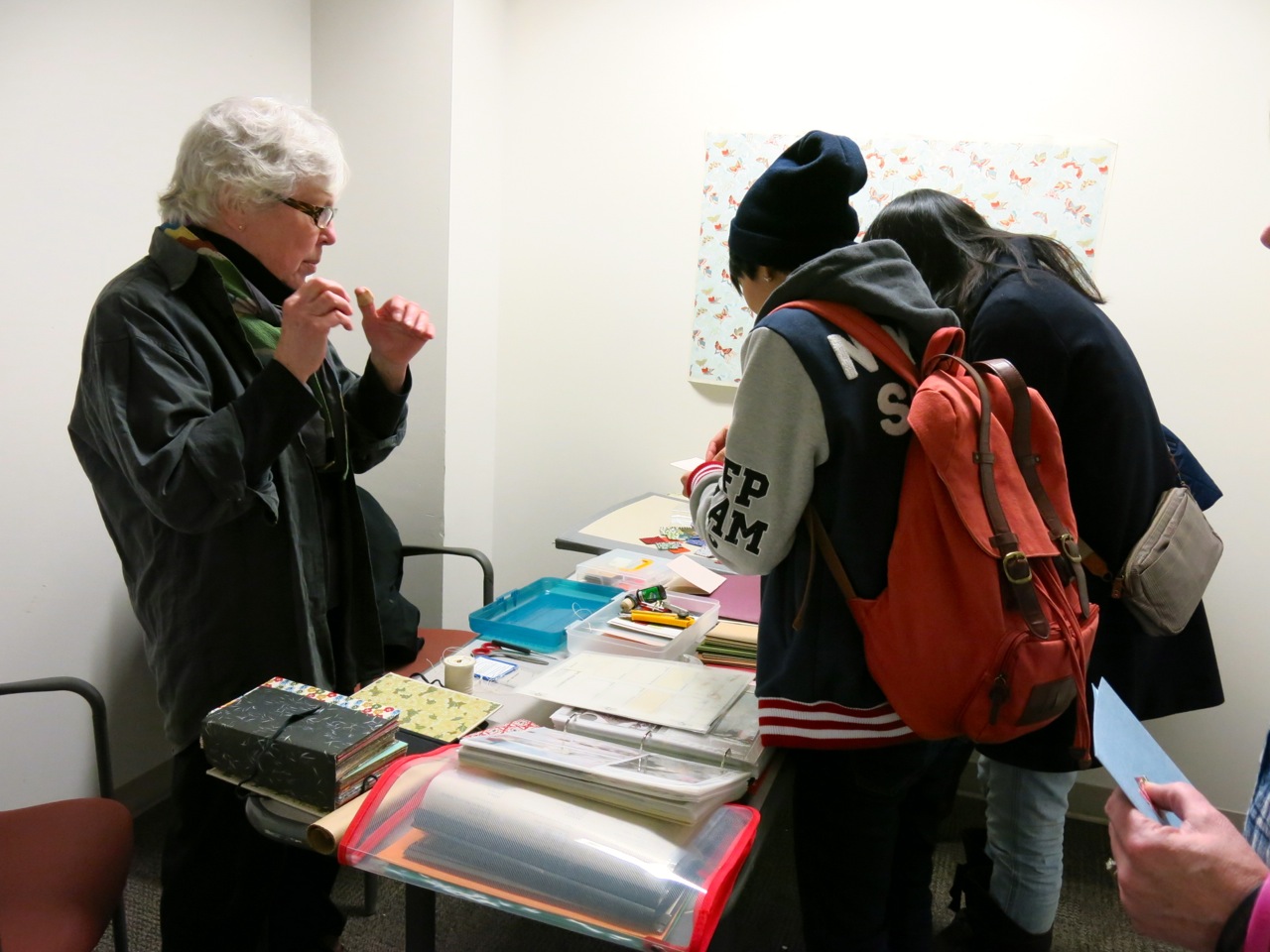
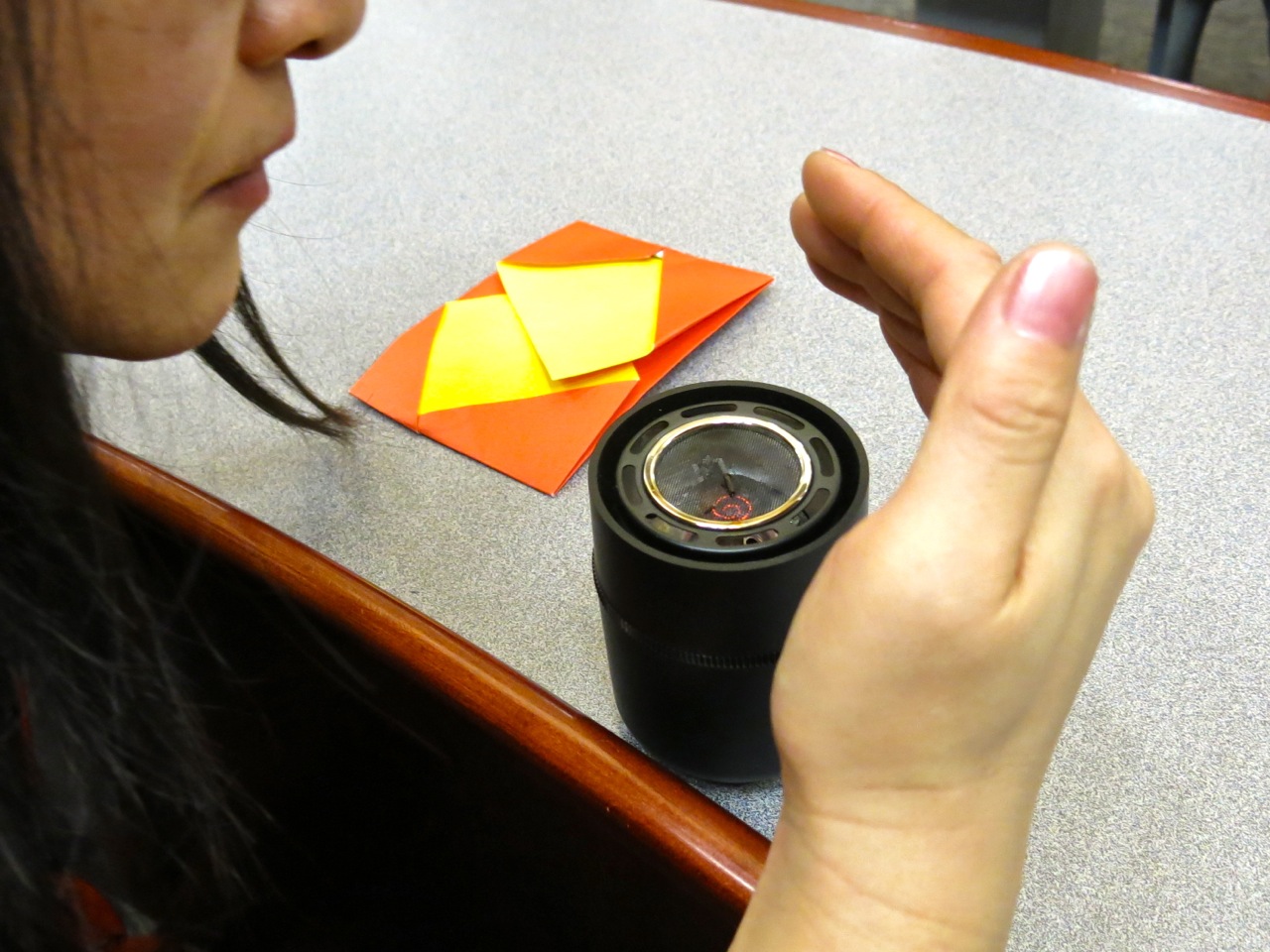
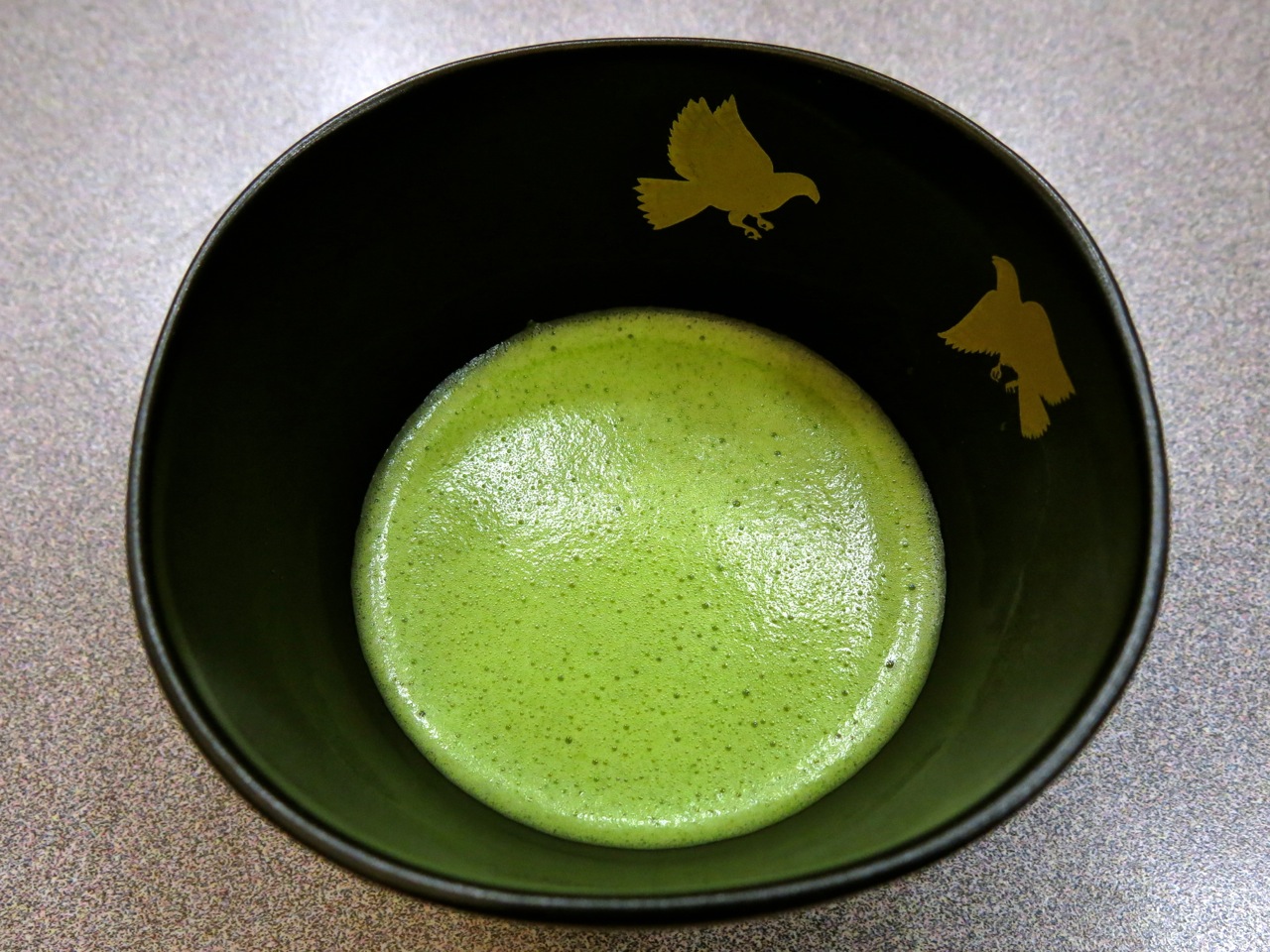
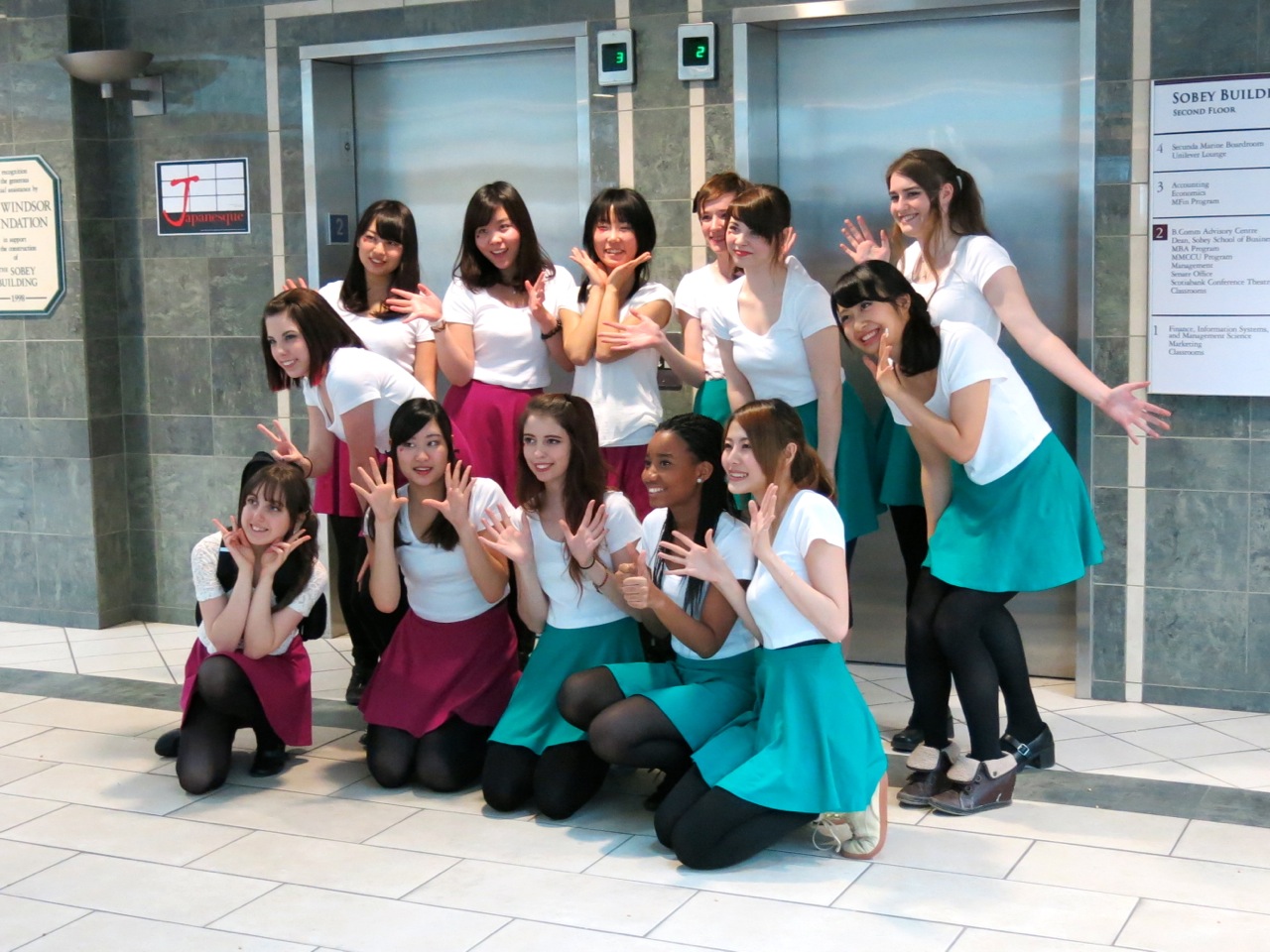
We were honoured to give the demonstration of ikebana.
L-R: Dr. J. Colin Dodds, President of St. Mary's University; Miyako Ballesteros, ikebana artist; and Mr. Tatsuo Arai, Consul General of Japan at Montreal.
Thank you to all who joined in the activities. We hope you enjoyed the afternoon! Thank you to all the organizers, supporters and sponsors for making this happen. It was a wonderful event and we hope to see you again next year.
All photos by the ikebana shop. All rights reserved.
My Ikebana: The Snowstorm Pine
After strong snowstorms like the last one we experienced, I always get gifts of fallen branches. The pine branch I used for this arrangement was one such gift.
Before starting on the arrangement, I took some time admiring this branch. The main branch, strong and straight was pointing towards the heavens.
There were also smaller curling branches which I situated horizontally over the mouth of the vase to appear like little wavelets.
The pink spray mums and oregonia leaves did not project any powerful and distinctive colours.
But they were perfect to create a sense of harmony. The straight pine branch rising from the sea, reaching for the sky, just visible in the horizon. Do you see it? :-)
Here is the whole arrangement.
I hope you like it. --Miyako
All photos by the ikebana shop. All rights reserved.